When Everything Becomes Money: The Coming Tokenization of Human Value
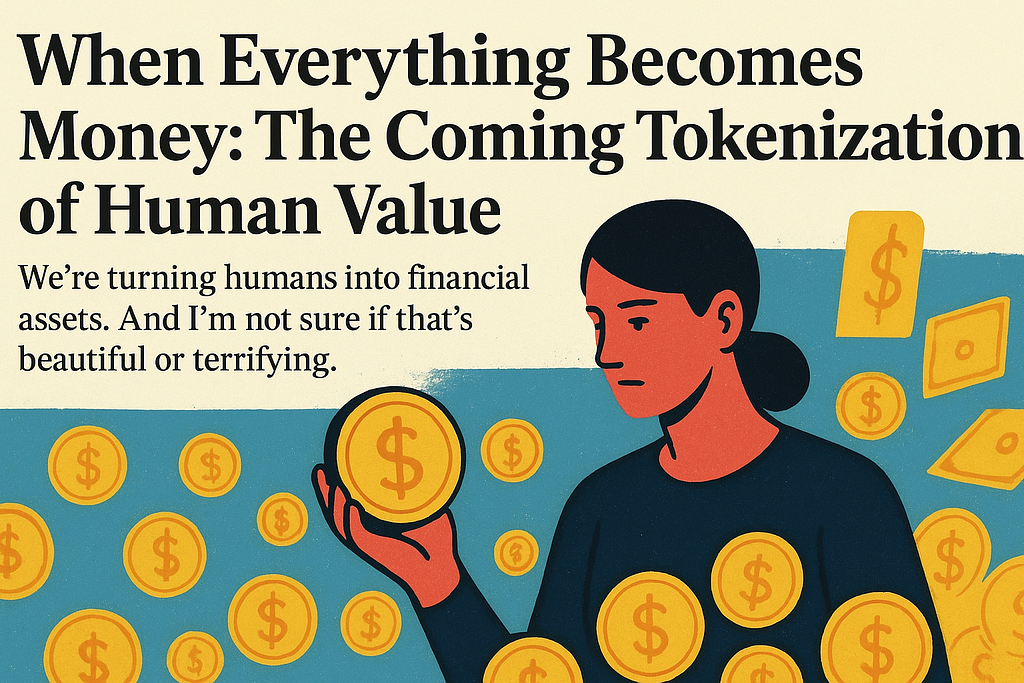
We’re turning humans into financial assets. And I’m not sure if that’s beautiful or terrifying.
My friend Sarah just tokenized her time.
Not metaphorically. Literally. You can buy 30 minutes of her UX design expertise for 0.05 ETH. Book directly on-chain. She minted 1,000 time tokens. Sold out in four hours.
“I pre-sold my entire year,” she told me, grinning. “I’m basically a human bond.”
That’s when it hit me: We’re not just tokenizing houses and stocks. We’re tokenizing ourselves. And once you see it, you can’t unsee it.
Welcome to the future where everything — including you — has a price tag.
The Human Stock Market
It started innocently. BitClout (now DeSo) let you buy shares in people. Literally shares. In humans.
My Twitter-famous friend Jake watched his token price swing from $50 to $500 based on his tweets. “I check my human stock price more than Bitcoin,” he admitted.
Think about that. People trading derivatives on someone’s social media performance.
We’ve crossed a line. I’m just not sure which direction we’re heading.
Time Isn’t Money. Time IS Money.
The Sarah thing fucked with my head, so I tried it.
I tokenized 100 hours of my time. “MAAZ tokens.” Each token = 1 hour of consulting. Transferable. Tradeable.
What happened next was insane:
- A startup bought 20 hours, held them for six months, sold 10 to another founder for 2x
- Someone created a liquidity pool: MAAZ/USDC
- My time started trading 24/7
- I woke up to find my hourly rate up 30% because someone in Tokyo decided I was undervalued
My time became a commodity future. Supply and demand, baby.
The Attention Economy Gets Real
Remember when “attention economy” was a metaphor? Not anymore.
My 19-year-old cousin earns BAT tokens for watching ads. Minds.com pays him crypto for likes. His Twitch streams mine coins for viewers.
“I make $50 a day just… existing online,” he said.
But here’s the dark part: He’s optimizing his entire life for token extraction. Won’t have conversations that don’t convert. Won’t create content that doesn’t monetize.
When everything has a price, nothing is priceless.
Your Data: The Oil of the 21st Century
Facebook made $150 billion last year selling your data. You got zero.
Now? Projects are tokenizing personal data. Browse, earn tokens. Share location, earn tokens. Health data, shopping habits, DNA — all tokenized.
My fitness tracker pays me 0.1 HEALTH tokens per workout. Sounds great until you realize I’m literally selling my biometric data for pennies while pharma companies make billions.
We’re not solving data exploitation. We’re just getting retail prices for our exploitation.
The Social Credit Nightmare
China’s social credit system was the warning. We’re building the same thing, just decentralized and financialized.
I met someone with a “reputation token” worth $10,000. Every interaction affects the price. Help someone? Token goes up. Piss someone off? Token crashes.
“I can’t afford to have a bad day,” she said. “Literally.”
When your mood has market value, are you still human?
Skills Becoming Securities
My developer friend tokenized his coding ability. 1,000 CODE tokens, each redeemable for one hour of programming.
But then speculators entered. They’re trading his tokens based on:
- His GitHub commits
- Stack Overflow reputation
- Tweet sentiment analysis
- Coffee consumption (seriously)
“Random VCs own 400 hours of my future,” he said. “I’m a walking derivative.”
The efficient market hypothesis applied to human potential. What could go wrong?
The Dating Market Literalized
This one’s rough. Dating apps are adding token incentives.
Match and chat? Earn tokens. Go on dates? More tokens. Relationship milestones? Token bonuses.
My friend Amy showed me her dating portfolio. She’s earning $200/month being single. “I’m yield farming relationships,” she laughed.
But she also hasn’t had a genuine connection in months. Every interaction is calculated for token optimization.
ROI on romance. We’ve monetized loneliness.
Kids: The Ultimate Growth Stock
Here’s where I draw the line. Parents tokenizing their kids’ future earnings.
Not joking. Platforms letting parents sell tokens backed by their child’s “future potential.” Investors buying shares in 10-year-olds based on test scores.
“It’s just like funding education,” they argue.
No. It’s turning children into securities. It’s feudalism with smart contracts.
The Beautiful Side (It Exists)
Not everything is dystopian. Some tokenization actually empowers people.
Artists: Musicians selling song royalty tokens directly to fans. Painters tokenizing future artwork. Creators keeping control while getting funded.
Students: Tokenizing future income to pay for education. No debt, just revenue sharing. Way better than student loans.
Freelancers: Predictable income through time token sales. Clients worldwide. No payment delays.
Communities: Local currencies rewarding neighborhood participation. Volunteer work earning real value.
When done right, tokenization democratizes value. When done wrong…
The Philosophical Mindfuck
What happens to human relationships when everything is transactional?
I helped my neighbor move last week. He tried to pay me in his personal tokens. I refused. It felt… gross.
“But you spent four hours!” he insisted.
That’s the point. Some things shouldn’t have prices. But in a tokenized world, not charging feels like losing money.
We’re creating a world where kindness requires economic justification.
The Resistance
Not everyone’s drinking the Kool-Aid. “Neo-Luddites” are creating token-free zones.
I visited one in Portland. Cash only. No tracking. No tokens. No optimization. Just… humans being humans.
“We’re not anti-technology,” the founder explained. “We’re pro-humanity.”
It felt like time travel. Also, like therapy.
Your Choice: Participant or Product?
The tokenization of human value is inevitable. The question is: How do you engage?
Option 1: Full Participation
- Tokenize your time, skills, data
- Optimize for token extraction
- Treat yourself as an asset
- Maximum financial gain
Option 2: Selective Engagement
- Tokenize professional skills only
- Keep personal life off-chain
- Balance money and meaning
- Sustainable approach
Option 3: Digital Minimalism
- Minimal tokenization
- Focus on intrinsic value
- Resist quantification
- Preserve humanity
I’m choosing Option 2. Tokenizing my professional value while keeping my soul off the market.
The Future We’re Building
In 10 years, everyone will have a personal token. Your reputation, skills, time, attention — all tradeable assets.
The optimistic view: Ultimate meritocracy. Value flows to value creators. No more gatekeepers.
The pessimistic view: Human experience reduced to financial instruments. Everything commodified. Humanity lost.
The realistic view: Both. Simultaneously.
We’re building a world where a homeless person could tokenize their story and fund a new life. Also where your grandmother’s cookies might need a pricing algorithm.
The Bottom Line
The tokenization of human value isn’t inherently evil. It’s a tool. Like fire. Or nuclear energy. Or the internet.
Use it wisely? Liberation. Use it carelessly? Dystopia.
The key is remembering that not everything valuable needs a value. Some things — love, friendship, kindness, wonder — transcend markets.
In the rush to tokenize everything, let’s not forget to remain human.
Because when everything becomes money, nothing is priceless.
And a world without priceless things isn’t worth living in.
Next week: “ Why Traditional Finance Will Die Fighting (And Still Lose)”
Building financial tools for humans, not human tools for finance at GloFi. Join us at glofi.io