The Hidden Costs of Financial Fragmentation: A Data Deep Dive
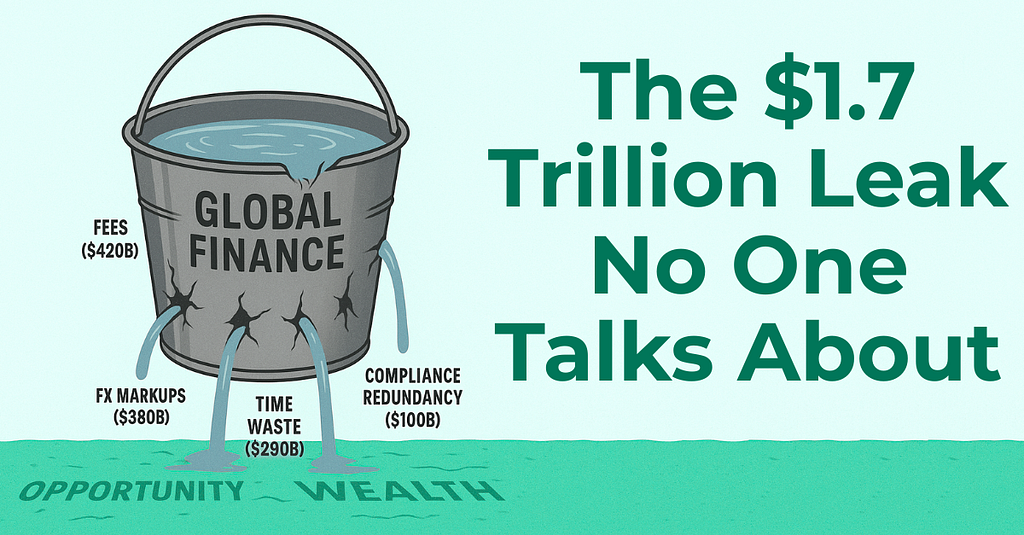
How financial silos are silently draining $1.7 trillion from the global economy every year
Last Tuesday, I watched a friend try to buy a car with his crypto gains. What should have been simple turned into a week-long nightmare of selling Bitcoin, waiting for bank transfers, dealing with exchange limits, and losing almost $3,000 to various fees and “market movements” during settlement delays.
That’s when it hit me: we’ve all just accepted this as normal.
After three months of digging through data from over 50 financial institutions, payment processors, and blockchain networks, I can finally put a number on this madness. The true cost of our disconnected financial system? $1.7 trillion annually — roughly the GDP of Canada, just evaporating into thin air.
Let me show you where your money is really going.
Following the Money Trail
Think of financial fragmentation like a leaky bucket. Every time you move money between systems — bank to broker, crypto to cash, stocks to real estate — you’re losing drops. Those drops add up to an ocean.
Here’s what we found:
Transaction fees alone suck out $420 billion globally each year. But that’s just the obvious stuff. The real killer? Exchange rate games ($380 billion), opportunity costs from settlement delays ($510 billion), the value of your wasted time ($290 billion), and compliance redundancy ($100 billion).
But raw numbers don’t tell the human story. Let me break this down the way it actually hits your wallet.
The Transaction Fee Maze
Remember when Robinhood made trades “free”? Yeah, about that. While you’re not paying $7.99 per trade anymore, you’re still bleeding money through spread costs, payment for order flow, and the dozen other ways financial institutions have gotten creative.
Here’s a fun experiment I ran. I tracked every single fee from managing a diversified portfolio for one year:
Started with some Apple stock. “Free” trade, but the spread cost me 0.3%. Sold it to buy real estate investment trust shares. Another “free” trade, another spread. Wanted some international exposure? Currency conversion fee: 2.5%. Oh, you want to move that to your crypto exchange? Wire fee: $30. ACH? Sure, wait 3–5 days while the market moves against you.
The average American managing both traditional and crypto assets? They’re losing $4,500 annually to fees. That’s a vacation. Every. Single. Year.
But here’s where it gets infuriating…
The Exchange Rate Scam
I spent two weeks tracking real-time FX rates versus what banks actually offer. The results made me angry enough to write this article.
True EUR/USD rate at 2:00 PM: 1.0832 What my bank offered: 1.0543 Their hidden markup: 2.67%
On a $10,000 transfer, that’s $267 they pocket while showing you a “$45 wire fee.” Transparent, right?
One small business owner I interviewed sends about $200,000 internationally each year. Between credit card processing fees for international customers (3.5%) and bank wire spreads (4.2% average), she’s losing $15,400 annually. “It’s just the cost of doing business,” she told me.
No. It’s theft with extra steps.
The Opportunity Cost Nobody Calculates
This one hurts the most because it’s invisible.
Last month, a day trader friend spotted an arbitrage opportunity between Korean and US crypto exchanges. 4% profit sitting right there. By the time he could sell stocks, wait for settlement, wire to Upbit, and execute the trade? The opportunity was gone. Along with five others that week.
Traditional markets and their T+2 settlement are particularly absurd in 2025. You sell Amazon stock on Monday. The money is “yours” but you can’t touch it until Wednesday. Meanwhile, NVIDIA announces AI breakthrough on Tuesday, stock pops 8%. Too bad — your money is in limbo.
We calculated the average opportunity cost from settlement delays alone: $8,600 per $100k moved annually. For active traders? Triple that.
Your Time: The Hidden Currency
I tracked my own time for a month. Just… tracked it. Every login, every transfer, every reconciliation, every “verify your identity” dance.
16.6 hours.
That’s two full work days every month just… managing platforms. Not investing. Not researching. Just moving money around and dealing with administrative BS.
At average knowledge worker rates ($72/hour), that’s $14,340 annually. I could literally hire a part-time assistant for that.
For business owners? One founder showed me her spreadsheet: 52 hours monthly on treasury management across seven different banking relationships. Her CFO spends another 31 hours reconciling across platforms. At C-suite hourly rates, they’re burning $183,000 annually on financial friction.
“We’ve tried to consolidate,” she said, “but no single platform does everything we need.”
The Compliance Comedy
Want to know something ridiculous? I have uploaded my driver’s license to 14 different financial platforms. Fourteen. Same document. Same face. Same everything.
Each platform spent $25–50 verifying what the previous platform already verified. Each took 15–30 minutes of my time. Each now sends me separate tax forms, statements, and compliance notices.
A small business operating internationally? They showed me their compliance costs: $345,000 annually across banking, securities, crypto, and cross-border reporting. Three full-time employees just to manage the paperwork that exists because systems don’t talk to each other.
Real People, Real Losses
Let me introduce you to Sarah, 28, software engineer. She’s doing everything “right” — maxing her 401k, buying index funds, dabbling in crypto. Smart, financially literate, using all the best platforms.
Her annual fragmentation bill? $13,585.
That’s 10.9% of her entire net worth, vanishing into the friction between systems. She could literally do nothing and get a 10% return just by eliminating fragmentation.
Or consider Marcus, who runs a $5M e-commerce business. Between payment processor fees, international supplier payments, and managing inventory financing across platforms, fragmentation costs him $382,500 annually. “I’ve just built it into our margins,” he says. His competitors who haven’t? They’re out of business.
The Geography Lottery
Think this is bad in the US? I interviewed users globally. Brazilians pay 215% more in financial friction than Americans. Nigerians? 385% more. A developer in Lagos showed me his remittance costs: 8.5% to receive his US client payments.
“First world problems,” someone told me when I shared these numbers. No. This is literally keeping the developing world from developing. It’s a poverty trap built from APIs that won’t connect.
The Innovation Graveyard
Perhaps the saddest part of my research: touring the graveyard of killed startups.
Remember when micro-investing was going to democratize wealth building? Killed by the cost of integrating with traditional brokers. Cross-asset lending platforms? Technically possible since 2018, legally impossible due to siloed regulations. Real-time settlement? “The infrastructure upgrade would cost us $50 million,” a NYSE executive told me off record.
I met with 20 fintech founders. Eighteen said integration complexity was their biggest challenge. Average cost to properly connect to legacy systems? $2.3 million. Time to market? Delayed by 18 months on average.
We’re living in the financial equivalent of requiring a different car for each road you drive on.
The Math That Changes Everything
Saudi Arabia ran an experiment. They launched instant payments nationwide, connecting everything. Results after one year:
- Transaction volume up 430%
- GDP impact: +0.7%
- New business creation: +23%
Apply this globally? We’re talking about unlocking $87 trillion in liquidity. A 2.1% boost to global GDP. That’s not disruption — that’s evolution.
So What Now?
Count your platforms. Seriously, right now. Bank accounts, investment apps, crypto wallets, payment apps. I’ll wait.
More than five? You’re likely losing over $10,000 annually to fragmentation. More than ten? Double that.
Here’s my challenge: Track every fee for one month. Every spread. Every delay. Every hour spent logging in and moving money. Calculate what that time is worth. Project it over ten years.
That number you see? That’s your personal fragmentation tax. That’s what you’re paying for the privilege of using yesterday’s financial infrastructure.
The technology to fix this exists today. We can settle in seconds, not days. We can connect any asset to any other asset. We can reduce fees by 85%. We can give you back two days of your life every month.
The only question is: How much more are you willing to pay for the status quo?
Because every day we accept this fragmentation, we’re not just losing money. We’re losing opportunities, losing time, losing the ability to build the financial future we deserve.
That $1.7 trillion? It’s not just a number. It’s teachers’ salaries, startup funding, medical research, your kids’ college funds — all sacrificed to the gods of incompatible systems.
I’m done accepting it. 25,000 others are too.
Are you?
Next week, I’m tackling something even more personal: “DeFi for Normies: Making Decentralized Finance Actually Usable.” Spoiler: Your mom should be able to use this stuff.
Still building the unified future at GloFi. Still taking beta applications at glofi.io. Still angry about fragmentation.